
 You’re closer to your ideal weight after practicing healthy eating and exercise habits, but you’re still unhappy with the appearance of your abdomen. You might be frustrated that your belly is still flabbier than you’d like it to be, that it retains a bulge you can’t flatten, or that loose, sagging skin makes you embarrassed to show your midriff. You’re considering treatment to take you that last step to a firm, flat, trim midsection, but you’re not sure which to choose.
In this article, we’ll explain your treatment options and help guide you to the best choice, based on your goals.
It’s Your Body, Your Priorities, and Your Choice
Every body is different and responds in different ways to aging, weight changes, and pregnancy. And every individual has different priorities in life — not just about how they look, but how much time they can take for treatment and how quickly they’d like to see results. Here are the key factors to consider as you weigh your treatment options:
- Your body. Different cosmetic treatments correct different sets of body problems. If your main problem is with pockets of diet- and exercise-resistant fat and your skin is resilient and your abdominal muscles tight, then less-invasive treatment may be your answer. If your skin and muscles have stretched beyond the point where they are able to spring back, surgery may be a better choice.
- Your schedule. Different treatments have different timelines. Noninvasive treatments take longer to produce results but don’t involve downtime. Surgical procedures produce final results as soon as you heal from the procedure but require downtime for recovery.
- Your goals. Will you be happy with a modest, incremental improvement? Or do you want a more dramatic transformation?
Tummy tuck
A tummy tuck is surgery to tighten loose skin, repair weakened and separated abdominal muscles, and remove excess fat. It’s major surgery, but it’s the most transformative of the procedures to repair a flabby, bulging belly. With a tummy tuck, you’ll get a firm, flat, smooth abdomen and a slimmer waistline. If you have loose, sagging skin on your stomach and your belly bulge is from muscles that no longer hold your midsection flat, a tummy tuck is the only procedure that can restore a youthful appearance.
While a tummy tuck can work wonders to improve your appearance, it does require downtime for recovery. Most patients take at least two weeks off from work, and it can take several more weeks before they feel completely back to normal. For a sense of the results you can expect from a tummy tuck, view our before-and-after photo gallery.
Liposuction
Liposuction is a minimally invasive procedure to remove pockets of excess fat. It’s a body-contouring procedure, not an overall weight-loss treatment, as it targets specific areas of diet- and exercise-resistant fat. In liposuction, a thin tube, or cannula, is inserted through small incisions and used to break up and remove fat deposits. The fat cells removed in liposuction are gone forever and they won’t grow back. If you gain weight after treatment, the remaining fat cells will increase in size, but there are fewer of them in the treated area, so your stomach will remain proportionally slimmer. Liposuction does not work to tighten loose skin or repair weakened abdominal muscles.
Most patients need a few days to a week of downtime after liposuction and may have some short-term swelling and bruising. The slimming effects are visible immediately, and final results appear after about three weeks. You can see examples of these results in our before-and-after photo gallery.
CoolScultping
CoolSculpting is a remarkable new treatment that uses precisely controlled cold temperatures to destroy fat cells where excess fat lingers in pinchable bulges. The technology uses a cooling device that surrounds the area to be treated, chilling the fat to the point where it is damaged, without hurting skin, muscle, and other surrounding tissue. In the weeks following treatment, these damaged fat cells are naturally processed out of the body as waste.
You’ll have no downtime after a CoolSculpting session. You can walk out of treatment and go straight back to work or resume your normal activities. Final results appear about three months after treatment, and it can take more than one session to achieve optimal results.
Learn More About Abdominal Treatments in Beverly Hills
Dr. David Kim and Dr. Eugene Kim at Beverly Hills Plastic Surgery have developed an impeccable reputation for stunning, natural-looking cosmetic treatment and plastic surgery results, attracting patients from all over the world. Contact our practice today at (310) 746-5475 or send an online request to schedule a consultation and a recommendation on the abdominal treatment — or treatments — best suited to your needs. For many patients, a combination of procedures is the ideal solution.

If you’ve committed to losing weight this year, that’s great!
We recommend a slow and steady approach of shifting to healthier foods that you enjoy, in smaller portions, paired with a regular and sustainable routine of increased physical activity. The combination of fewer calories in and more calories burned, accomplished by adopting a set of habits that become second nature to you, can be the key to losing weight and keeping it off. Beyond that, it’s all about what works for you.
But have you thought about what you’ll do after you lose the weight?
Body Contouring
If you’re lucky, your weight will come off in all the right places and you’ll be delighted with your slimmer body contours. But weight loss doesn’t always work that way. Many people are left with stubborn pockets of fat that are resistant to diet and exercise. Those might be around your waist, on your arms or thighs, or under your chin. Wherever the last bulges of fat persist, there are ways to get rid of them without going to extremes in dieting or at the gym.
Once you’re close to your weight goal — within about 10 or 15 pounds of your ideal weight — you might think about a body-contouring procedure to put the finishing touches on your self-improvement efforts. These procedures reduce unwanted pockets of fat on specific areas of your body in ways that eliminate those fat cells forever. They aren’t weight-loss treatments, but they make great complements to weight loss through healthy eating and exercise.
- CoolSculpting eliminates pinchable areas of excess fat by chilling it to low temperatures. The cooling damages the fat cells while the skin, muscle, and connective tissue are unaffected. In the weeks following treatment, the damaged fat cells are naturally processed out of your body for a long-lasting slimming effect.
- Liposuction uses small incisions to extract unwanted bulges of fat through a suction tube, or cannula. Once the excess fat is removed, that part of your body will have fewer fat cells permanently. Liposuction can remove fat from many parts of the body, including the abdomen, hips, thighs, upper arms, and chin.
- A tummy tuck goes even further in flattening and toning your midsection. The surgery removes excess skin that may sag and droop after weight loss. The procedure can also tighten and reconnect abdominal muscles to restore a firm, flat belly.
Breast Surgery
Weight loss can sometimes affect a woman’s breasts in ways that are less than desirable. Stretched breast skin can sag when the fat is gone, or your breasts can lose more volume than you would prefer.
- A breast lift corrects sagging breasts by removing excess skin and reshaping the breast to a rounder, more uplifted, and younger-looking form.
- Breast augmentation uses implants or fat transfer to increase breast volume, shape, and projection.
Mommy Makeover
A mommy makeover combines procedures—typically a tummy tuck, breast surgery, and liposuction—to restore a more attractive, younger-looking figure. A mommy makeover can provide the finishing transformation after successful weight loss to give you the body you want.
Facial Rejuvenation
As you get your body in beautiful shape, you might consider treatments to make your face look younger, too. You have many options for facial rejuvenation, including:
- Facial fillers to soften lines and wrinkles, add volume to hollowed areas, or plump your lips
- Botox to smooth lines and creases caused by repeated facial expressions
- A facelift to correct loose, saggy skin, eliminate facial wrinkles, get rid of jowls, and restore a well-defined jawline
Learn More About Body Contouring and Other Rejuvenating Treatments in Beverly Hills
Find out more about the possibilities of cosmetic treatment in a personal consultation. Dr. David Kim and Dr. Eugene Kim at Beverly Hills Plastic Surgery have developed an impeccable reputation for stunning, natural-looking cosmetic treatment and plastic surgery results, attracting patients from all over the world. Contact our practice today at (310) 746-5475 or send an online request to schedule an appointment.
 A tummy tuck flattens and firms your abdomen, removing excess skin that has stretched and sagged, and tightening and reconnecting loose and separated abdominal muscles. It’s common to add liposuction to a tummy tuck for an even greater slimming effect. Here’s an explanation of how the two procedures work together and why you might consider combining them.
What’s the Difference Between a Tummy Tuck and Liposuction?
A tummy tuck and liposuction are both body contouring procedures, designed to trim and flatten areas of your body when you are close to your ideal weight. But the two procedures are quite different from each other.
A tummy tuck is a surgical procedure to remove excess skin from the abdomen. It often includes steps to tighten and reconnect the abdominal muscles if they have stretched or separated as a result of pregnancy or significant weight changes. The result is a firmer, flatter belly and a tightening of the waist. A surgeon can also trim excess fat as part of a tummy tuck, but only in the immediate surgical area, which is the center of the abdomen.
Liposuction uses a suction tube, called a cannula, inserted through small incisions, to remove pockets of fat that resist slimming with diet and exercise. It’s possible to use liposuction almost anywhere on the body where unwanted fat accumulates, including the belly, waist, back, thighs, arms, and under the chin. Liposuction does not tighten loose skin or restore firmness to stretched and weakened muscles.
Why You Might Consider Adding Liposuction to a Tummy Tuck
If your problem is with loose skin and weakened abdominal muscles, and you don’t have excess fat on your belly or around your waist, a tummy tuck alone is probably what you need. And if your problem is with stubborn abdominal fat, and your belly skin and muscles are tight and resilient, liposuction alone might be a good solution.
However, if your concerns include loose abdominal skin, a bulging belly from weakened muscles, and excess fat on your belly and around your waist, a combination of the two procedures – called a lipoabdominoplasty – may be your best choice.
Here are some benefits of combining the two procedures.
- One surgery, one recovery: Both procedures involve surgery, and both require downtime for recovery. By combining them, you’ll need to schedule a single surgery, and you’ll only have one recovery period. Recovery from a tummy tuck with liposuction is usually similar to recovery from a tummy tuck alone.
- Cost-effective: It’s less expensive to have a tummy tuck and liposuction as a combined procedure than it is to have them separately. For example, you’ll have a single charge for anesthesia, and there can be other efficiencies in doing both procedures at the same time. Of course, cost shouldn’t be the driving factor in your decision. You should pay more attention to choosing a skilled surgeon with a track record of excellent outcomes. But plastic surgery can be a big investment, and you want to spend your money wisely.
- Better results: Combining a tummy tuck with liposuction can give you better body-contouring results than either procedure on its own. You’ll get the skin-tightening and muscle-toning effects of the tummy tuck, with a flatter, firmer abdomen. And liposuction can trim excess fat from your waist and areas beyond the reach of tummy tuck surgery.
- Contour more than one area: Your surgeon may be able to combine a tummy tuck with liposuction on another part of your body — your thighs or hips, for example — for more comprehensive body contouring.
Learn More About Body Contouring in Beverly Hills
Dr. David Kim and Dr. Eugene Kim at Beverly Hills Plastic Surgery have developed an impeccable reputation for stunning, natural-looking cosmetic treatment and plastic surgery results, attracting patients from all over the world. Contact our practice today at (310) 746-5475 or send an online request to schedule a consultation.

For many of our Beverly Hills patients, liposuction surgery is a great way to shed stubborn pockets of fat that are resistant to exercise. However, the best results come when patients are already close to the ideal weight before starting liposuction treatment. Here’s why:
Liposuction vs. Weight-loss surgery
Since its introduction, liposuction has become synonymous with beautiful figures. The surgery is known for helping patients remove stubborn pockets of fat and reveal trim figures, even helping drop a couple of pounds on the scale. However, at its core, liposuction is fundamentally a body-contouring surgery. Unlike weight-loss procedures like gastric bypass which restrict food intake, liposuction treats minor to moderate fat deposits. No mechanisms in the liposuction treatment process target the main causes of weight gain – overeating, genetics and lack of physical activity. Best results are achieved when patients are committed to their well-being and have maintained a consistent, healthy weight.
Fat Loss Does Not Necessarily Mean Weight Loss
As liposuction does not target the culprits behind weight gain, the treatment does not necessarily equate to weight loss. While some patients may see a few pounds come off following treatment, even removing significant pockets of fat won’t drastically change the number on the scale. The best way to lose weight is not by removing fat with liposuction – it’s by eating a healthy diet and replacing excess fat with strong, lean muscle.
Liposuction Is Only Effective When You Maintain Weight
Fat is unique compared to other cells in that they fluctuate in size as an individual gains weight. While the cells can shrink and can be removed through liposuction, remaining fat can become enlarged with poor health habits. Achieving your ideal weight and staying there is an important step in keeping your post-liposuction body. Substantial weight gain may require additional recontouring procedures.
Eliminating as much fat as possible through diet and exercise, before undergoing liposuction, also has a positive impact on your treatment results. Bumps and lumps of fat that linger can then be specifically removed during surgery, maximizing your results and improving overall appearance. While liposuction can certainly be used in cases where patients are still working towards a healthy weight, premature treatment may mean that patients must come back for additional liposuction once they’ve achieved their goal weight.
Your Health is the Top Priority
While liposuction is completed with small incisions and with the use of a thin tube that extracts fat cells, it nonetheless remains a surgical procedure. As with other procedures, the surgical process may not be suitable for overweight or obese patients due to the increased risk of complications. Rather than putting your health on the line, spend the time working with a physician to shed the weight naturally before turning the cosmetic treatments. At Beverly Hills Plastic Surgery, our experienced team has worked with countless patients to provide liposuction and other body contouring solutions once they’ve reached a healthy weight.
Is Now the Time for Liposuction? Find out at BHPS
When it comes to providing exceptional care, the surgeons at Beverly Hills Plastic Surgery focus on evaluating a patient’s current needs, their expectations, and realistic results. Together, we serve as your partner in achieving your ideal appearance and figure. For patients thinking about liposuction, we recommend coming in for a preliminary consultation to explore your options and develop a treatment strategy. Call Dr. David Kim and Dr. Eugene Kim at (310) 746-5475 to get started.
 Stubborn pockets of fat can be difficult to target, even with an intensive workout regimen and a great diet. Individuals who find themselves in the boat of being close to achieving their dream figure but are blocked by these stubborn bumps find liposuction to be a great option – and for good reason. While the treatment may best be known for removing stubborn fat from the abdomen, liposuction is among the most versatile plastic surgeries available. Furthermore, the treatment’s versatility makes it possible for patients to recontour almost any part of the body, from the neck to the thighs. In recent years, certain areas have emerged as the most popular liposuction treatment areas:
Waist, Hips, Abdomen
For men and women alike, a smooth, flat stomach or washboard abs can be a source of pride once finally achieved. However, if you find yourself with love handles or a muffin top, no number of crunches or carb cutting can completely remove these lovingly named pockets of excess adipose tissue (fat cells).
Using liposuction to help remove extra fat and smooth out these areas is a popular option for men and women, especially in the months leading up to summer vacations. By removing the unnecessary layer of fat tissue from the abdomen, lips, and waist, patients feel more confident in their appearance, whether preparing for a beach trip or wearing form-fitting clothes that show off their physique.
Abdominal liposuction isn’t just ideal in the months before an upcoming trip. Many women turn to lower abdominal liposuction as a way of restoring femininity to their bodies after birth and incorporate this surgery as part of their larger mommy makeover.
Chest and Back
For many men, the ideal physique is one with a broad, well-defined chest and back. However, age and diet can lead to pockets of fat developing in these areas, creating a flabbier, less toned appearance that can quickly derail your self-confidence. As more men have embraced the benefits of plastic surgery, more are turning to liposuction in these areas as a way of enhancing their gym results while looking natural.
Among women, liposuction of the back and chest are also quickly becoming incredibly popular options for removing unpleasant bra rolls that can appear beneath clothes. When liposuction is used on the chest, it can add greater definition and offers results like a breast lift.
Upper arms
Do you avoid wearing tank tops or lifting your arms more than necessary due to excess fat? If so, you are not alone. Using liposuction to improve definition of the upper arm is an increasingly popular treatment option among men and women. In addition to helping create greater tone in the arm, using liposuction in this part of the body allows individuals to reap the benefits of an arm lift without the impacts of major plastic surgery.
Legs, Thighs, Buttocks
Aside from the abdomen, the lower body is perhaps the most popular treatment area for liposuction. For many, fat collects at different parts of the thighs and around the buttocks. The inner thighs, outer thighs, the front of the thighs and area below the buttocks are popular areas that can all be recontoured with the help of liposuction.
Achieve your Dream Appearance
You don’t need major plastic surgery to achieve your dream figure. For many who are struggling with removing the last few lumps and bumps from their appearance after sticking to an effective workout routine, liposuction is an excellent, minimally invasive option adapted to your needs. At Beverly Hills Plastic Surgery, our experienced surgeons can create the personalized treatment strategy you need to achieve your dream appearance. Call today to get started!
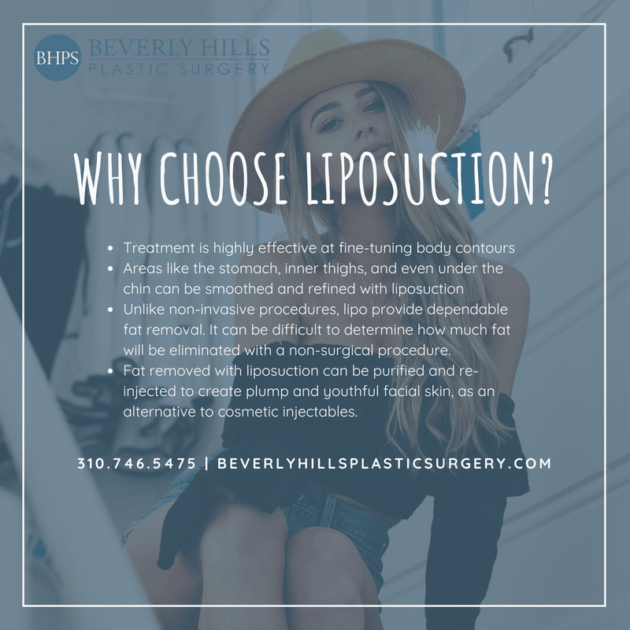
No matter how strict your diet is or how intense your exercise regimen is, there still might be certain fat deposits that just won’t budge. Fortunately, liposuction can help get rid of those last bits of stubborn fat. Read our infographic below to find out why you should choose to undergo liposuction.
If you’re interested in liposuction, contact us today.
 When it comes to removing undesirable fat deposits and reshaping your figure, you’ve undoubtedly heard of liposuction and its less invasive counterpart, CoolSculpting, as two of the most effective methods currently available.
Both liposuction and CoolSculpting share the same goal – to re-contour targeted areas of your body – but there are several key differences in the two approaches. So how do you decide which is right for you?
While CoolSculpting illustrates the growing popularity of non-surgical cosmetic procedures, liposuction offers a surgical approach to eliminating fatty tissue. This guide presents the “skinny” on both techniques to help you choose between them.
What Is Liposuction?
Despite maintaining a healthy lifestyle, many people find themselves struggling with fat accumulating on specific areas of their body. These circumstances are often due to hereditary or hormonal factors that are outside their control. That’s why liposuction remains one of the most popular plastic surgery procedures in the world.
Liposuction removes excess fat from specific areas of the body – including the abdomen, hips, buttocks, thighs, knees, upper arms, chin, cheeks, and neck – by vacuuming out fat cells through a small tube called a cannula. Provided you remain within your target body weight, the fat cells removed via liposuction are unlikely to return.
While liposuction can deliver somewhat more dramatic results than CoolSculpting, neither approach is a substitute for natural weight loss, or as a treatment for obesity. You should only undergo liposuction if your goal is to contour problem areas where you have been unsuccessful at losing the fat through diet and exercise.
How Liposuction Works
Since liposuction first became available in the 1980s, there have been many refinements and advancements to the techniques doctors use to perform the surgery, which have provided patients with better results and shorter recovery times.
- Fluid injection: In this method, doctors inject a solution made with saline, epinephrine, and lidocaine into the targeted area before beginning the fat removal process. This approach not only anesthetizes the area before the surgery and helps surgeons remove the fat with less difficulty, but it also minimizes blood loss and bruising.
- Ultrasound-assisted: Liposuction assisted with laser or ultrasound, liquefies the fat before the doctor removes it from your body.
- Tumescent: The word “tumescent” means “swollen.” With the tumescent approach, surgeons inject a large amount of local anesthetic fluid into the treatment areas, which causes them to appear swollen. The tumescent liposuction technique eliminates both the need for general anesthesia and need for IV narcotics and sedatives.
- Super-wet: This procedure takes a similar approach to the tumescent technique but uses about half the amount of fluid.
As with any surgical procedure, there are some potential complications associated with liposuction, which include bruising, swelling, numbness, infections, blood clots and irregular skin contouring. However, choosing to undergo liposuction under the care of an experienced, cosmetic surgeon will significantly minimize these risks.
Who Is A Good Candidate for Liposuction?
Ideal candidates for liposuction share these qualities:
- Have good skin tone and elasticity so that the skin can bounce back from the procedure.
- Are physically and mentally healthy.
- Do not smoke.
- Do not have health conditions such as diabetes or heart disease.
- Have realistic expectations for the surgery.
What Is CoolSculpting?
Though freezing off fat may sound like something out of a sci-fi novel, that’s precisely how CoolSculpting, also known as cryolipolysis, works. This FDA-approved procedure is based on a scientific principle that frozen fat cells get flushed out of your body through natural processes – without harming the skin or surrounding tissue.
CoolSculpting is best for people who are within their target body weight, but who want to remove stubborn pockets of body fat that resist diet and exercise. Most CoolSculpting patients choose to treat their abdomen, “love handles,” back, upper arms, or thighs.
How CoolSculpting Works
For many people, the best part of CoolSculpting is that the entire process is non-surgical and requires no restrictions on activity or diet. The treatment uses a controlled device to draw fatty tissue into an applicator cup between a pair of panels, which freeze fat cells until they crystallize.
Though you may feel a pulling, pinching, or tingling sensation as the applicator first goes to work, these feelings lessen within about 10 minutes as the treated area goes numb. Many people choose to read or even take a nap while undergoing a CoolSculpting session. Since there is no need for downtime after the procedure, you can return to work immediately, with none of your co-workers knowing how you spent your lunch break.
Compared with surgical procedures, which leave patients with stitches, bruising, and scars, CoolSculpting’s side effects are relatively minimal and include numbness, tenderness, redness, and swelling of the targeted area. You can manage any discomfort with over-the-counter pain medicine.
The results of CoolSculpting are not immediate but reveal themselves gradually over the course of several months. That’s why the procedure also appeals to people who prefer to keep their treatments private. We recommend two to three treatments, spaced four weeks apart.
Who Is A Good Candidate for CoolSculpting?
CoolSculpting is an excellent option for patients who:
- Are at a healthy body weight but wish to target small fat bulges.
- Do not want to undergo surgery or anesthesia.
- Want to avoid a lengthy recovery period.
- Are looking for a permanent solution to sculpt specific areas of their body.
- Need to seek a non-invasive treatment due to health concerns.
Book Your Confidential Consultation Today
If you are interested in getting liposuction or CoolSculpting in the Beverly Hills area, schedule a consultation with us to discuss your goals and expectations. Though both procedures have a long track record of being safe and effective, you are nonetheless choosing to make changes to your body that require you to weigh all the pros and cons. Our qualified, cosmetic surgeons can help you decide which option is best for you.
 You exercise regularly and count your caloric intake, but you still can’t seem to banish your bulging belly. You’re not alone. Tummy fat, especially the type called visceral fat, becomes increasingly troublesome as we age.
Visceral fat is a type of fat found deep within your abdominal cavity, surrounding internal organs such as your intestines. Doctors have linked higher levels of visceral fat with health problems such as Type 2 diabetes, cardiovascular disease, and some types of cancer. Even if you work out most days of the week, you might still be fighting an uphill battle with your belly fat. What makes belly fat so difficult to conquer?
You might assume all fat cells are created equal, but in fact, you have two different kinds of fat cells: alpha and beta cells. Different areas of your body have a higher proportion of one type or the other. When it comes to body composition and fat loss, alpha cells are the enemy. It’s harder to lose body fat from areas that have more alpha cells. In contrast, you can burn stored fat more easily in areas of your body with a higher concentration of beta cells.
Alpha cells are associated with areas of stubborn body fat, which are often the waist and belly. As we age, both women and men tend to develop a higher ratio of alpha to beta fat cells in the abdominal region. That’s the reason for the “spare tire,” “love handles,” and “muffin top” that can be so hard to shed.
Aging is one factor associated with the concentration of alpha and beta cells in different areas of the body, but heredity is another influence. If you’ve noticed a tendency toward a specific body composition runs in your family, you can chalk it up to an inherited predisposition to have a higher ratio of alpha to beta cells in certain areas.
Why Exercise Helps You Get Rid of Belly Fat
If you exercise regularly and still find yourself with a roll of belly fat, the first thing to try is to increase the difficulty level of your workouts. Intense exercise leads your body to release more adrenaline, which helps stimulate fat burning. That’s why vigorous exercise, including high-intensity resistance training, is a powerful weapon in your ongoing battle with belly fat.
Exercise also helps you have more energy throughout the day, and both cardio and weight training offer considerable benefits across the board. If you’re trying to shed stubborn belly fat, your fitness regimen should include a balance of aerobic activity and weightlifting exercises. However, keep in mind that overtraining can cause you to reach a weight-loss plateau or even gain weight, so make sure to build rest days into your workout schedule.
You Are What You Eat
Unsurprisingly, diet is another factor influencing stubborn belly fat, especially the amounts and types of protein, fiber, and carbs you consume.
Protein
Lean protein helps you feel fuller longer, which reduces your urge to consume empty calories during the day. It also helps your body build muscle, which burns more calories even when you’re sitting still. Most people are getting the right amount of protein in their diet, but not necessarily from lean sources like fish, chicken, turkey, beans, and legumes. Instead, we’re putting red meat and cheese on our plates.
Fiber
Currently, Americans eat an average of 16 grams of fiber – the parts of plants our bodies can’t digest – daily. That’s about half the recommended amount of fiber. Like protein, fiber gives you a feeling of satiety, and it also leads to less insulin secretion and more short-chain fatty acids. All these factors add up to help you lose weight. Good sources of fiber include raw, unprocessed fruits and vegetables, as well as whole grains.
Carbohydrates
Contrary to what you may have heard, not all carbohydrates are bad. In fact, carbs fuel your body and brain throughout the day. However, refined carbs, such as those found in processed foods like white bread, make it harder for you to lose weight. Instead, eat healthy carbs like fresh fruits and vegetables.
The Role of Stress in Belly Fat
Anything that elevates your levels of cortisol – also known as the “stress hormone” – will make it harder to conquer stubborn belly fat. If you let stress get out of hand, including failing to get the right amount of sleep, you may have chronically elevated cortisol levels that are contributing to your inability to lose belly fat.
A healthy amount of exercise can be an effective form of stress release, helping lower cortisol levels naturally. However, be careful not to overdo it. Exercising too much, especially if you are also limiting your calorie intake, raises your baseline cortisol level and makes it harder to lose body fat. In fact, when your cortisol levels are high, fat tends to redistribute from other areas of the body, like your hips and thighs, to your belly. So, both mental and physical stress can increase stubborn belly fat.
Post-menopausal women also experience higher cortisol levels. That’s one reason so many older women have problems losing weight and experience an expanding waistline.
Manage stress using a method that works for you. Yoga and meditation are two of the most effective stress-relief tools. Also, be sure to get at least seven to eight hours of sleep per night.
The Bottom Line
Now that you understand why stubborn belly fat is so difficult to lose, you can develop a more strategic way to address it – including exercise, diet, and lifestyle changes. And, if you find even your concentrated efforts aren’t helping whittle down your middle, you can explore our surgical and non-surgical techniques for addressing belly fat, including a tummy tuck, liposuction, or CoolSculpting.